
ATV vs UTV: Which is Right for Your Dealership? A Complete Comparison Guide
By EverJoy Moto Product Selection Team | Updated September 2026 | Reading time: 12 minutes
Answer First: The Short Version
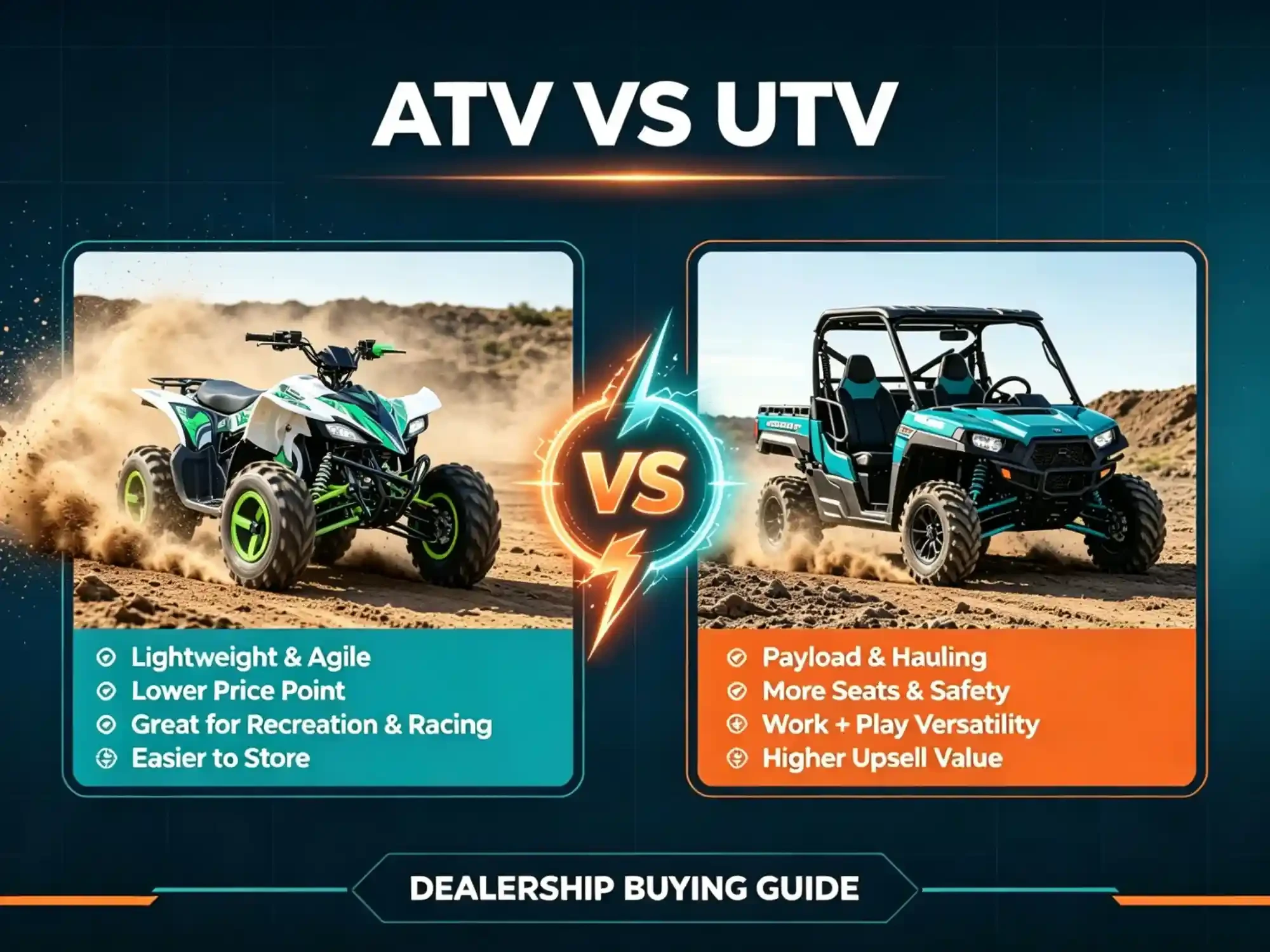
ATVs are more agile, lighter, and better for individual off-road riding and recreation. UTVs (Side-by-Sides) offer stronger cargo capacity and multi-passenger capability, making them better suited for farms, commercial operations, and family outings.
For most dealerships, the answer is not "either/or" — it's "both, in the right proportion." The ideal lineup depends on your local customer base:
- If your market is dominated by individual recreation riders, trail users, and youth/family entry-level buyers → Lead with ATVs, add UTVs as a premium upsell.
- If your market has strong farm/ranch, commercial rental, or large-family demand → Lead with UTVs, use ATVs as the accessible entry point.
- If your market is mixed → Carry both, position them as complementary rather than competing.
The rest of this guide breaks down the comparison across 7 dimensions, covers EverJoy's product lineup for each category, and provides a dealer selection framework.
📌 Key Takeaways
ATV = agility and accessibility. Straddle-style seating, handlebar controls, lighter weight, lower price point, easier to transport and store. Best for individual riders, youth entry, and trail recreation. UTV = capacity and utility. Side-by-side seating with steering wheel, roll cage, cargo bed, 2-4 passenger capacity. Best for farms, commercial use, large families, and users who need to carry people + gear. They compete, but they also complement. A customer who starts on an ATV may upgrade to a UTV as their needs change. A dealership that carries both captures the full customer lifecycle. Price points differ significantly. ATVs generally have lower entry prices and broader market reach. UTVs command higher prices and margins but require more floor space and service capability. EverJoy offers confirmed ATV platforms (FR125ATV-SP gas, FR60DATV-UT electric). UTV configurations are available through project coordination — specs pending verification with factory. Confirm UTV availability, specs, and certification with our sales team before planning inventory.
The 7-Dimension Comparison Table
| Dimension | ATV (All-Terrain Vehicle) | UTV (Utility Task Vehicle / Side-by-Side) |
|---|---|---|
| Seating & Controls | Straddle-style seat, handlebar controls (like a motorcycle) | Side-by-side bucket seats, steering wheel, foot pedals (like a car) |
| Cargo Capacity | Front/rear racks (typically 20-50 kg each); limited enclosed storage | Rear cargo bed (typically 150-450 kg); dump bed option on many models |
| Passenger Capacity | 1 rider (some models allow a passenger, but not standard) | 2, 4, or 6 passengers depending on model |
| Maneuverability | Narrower, lighter, tighter turning radius; better on tight trails and technical terrain | Wider, longer, heavier; more stable at speed but less agile on tight trails |
| Flexibility & Transport | Lighter (70-300 kg); fits in truck beds or on small trailers; easier to store | Heavier (300-800+ kg); requires larger trailer or flatbed; more storage space needed |
| Price Range | Lower entry price; broader market accessibility (specific pricing confirm with sales) | Higher price point; premium margins but higher inventory investment (specific pricing confirm with sales) |
| Primary Use Cases | Trail riding, recreation, hunting, youth entry, light farm tasks | Farm/ranch work, commercial operations, large family recreation, hunting with gear, rental fleets |
| Target Customer | Individual riders, enthusiasts, youth/family entry-level buyers, casual recreation users | Farmers/ranchers, commercial operators, large families, rental businesses, utility-focused buyers |
This table is a general industry comparison, not model-specific specifications. Actual capabilities vary by model, engine size, and configuration. Verify specific specs per model before purchasing.
Dimension 1: Seating & Controls — The Most Fundamental Difference
The seating and control layout is the single biggest difference between ATVs and UTVs, and it drives almost every other distinction.
ATV: Straddle + Handlebars
- The rider sits astride the vehicle, like a motorcycle
- Controls are handlebar-based: throttle, brake, clutch (if manual), steering
- Riding position is active — the rider shifts body weight to corner and navigate terrain
- Learning curve: similar to a bicycle or motorcycle; intuitive for new riders but requires balance and coordination
- Helmet and protective gear are essential — the rider is exposed
UTV: Side-by-Side + Steering Wheel
- Passengers sit next to each other in bucket seats, like a car
- Controls are automotive-style: steering wheel, gas pedal, brake pedal
- Riding position is passive — the vehicle's suspension and width handle stability; the driver steers like a car
- Learning curve: very low for anyone who drives a car; accessible to users who may not feel comfortable on a straddle vehicle
- Many UTVs include roll cages, seat belts, and sometimes doors — more enclosed protection
Dealer implication: Customers who are comfortable on motorcycles or bicycles tend to prefer ATVs. Customers who want a more "car-like" experience, or who want to carry passengers comfortably, tend to prefer UTVs. The control style is often the deciding factor for first-time buyers.
Dimension 2: Cargo Capacity — Work vs. Play
Cargo capacity is where UTVs clearly dominate, and it's the primary reason commercial and farm customers choose them.
ATV Cargo
- Front and rear racks are standard on most utility ATVs
- Typical rack capacity: 20-50 kg per rack (varies by model — confirm per model)
- Cargo is exposed to the elements and must be tied down
- Best for: carrying tools, hunting gear, small loads, coolers
- Limitation: not suitable for heavy or bulky loads; no enclosed storage
UTV Cargo
- Rear cargo bed is standard on most utility UTVs
- Typical bed capacity: 150-450 kg (varies significantly by model — confirm per model)
- Many models offer hydraulic or manual dump beds
- Cargo is contained in the bed; some models offer bed liners or covers
- Best for: farm supplies, tools, equipment, hunting gear with game, landscaping materials, commercial workloads
- Advantage: can carry significantly more weight and volume than an ATV
Dealer implication: If your customers ask "can it haul feed/equipment/supplies?", they need a UTV. If they ask "can it carry a cooler and some gear?", an ATV is sufficient. Cargo needs are a clear segmentation tool for qualifying customers.
Dimension 3: Maneuverability & Terrain Handling
ATV: Agility First
- Narrower profile (typically 90-120 cm wide) — fits on tight trails and between trees
- Lighter weight — easier to maneuver in technical terrain, less likely to get stuck in mud or sand
- Tighter turning radius — better for navigating obstacles and switchbacks
- Active riding position — the rider can lean and shift weight to improve traction and cornering
- Better for: tight wooded trails, technical off-road, motocross-style tracks, narrow paths
UTV: Stability First
- Wider profile (typically 140-170 cm wide) — more stable at speed, less likely to roll
- Longer wheelbase — smoother ride over rough terrain, better high-speed stability
- Heavier weight — more momentum through obstacles, but more likely to get stuck in deep mud or sand without 4WD
- Passive riding position — the vehicle's width and suspension provide stability; driver doesn't need to shift body weight
- Better for: open trails, desert running, farm roads, towing, high-speed recreation, rough terrain where stability matters
Dealer implication: Trail riders and technical off-road enthusiasts prefer ATVs. Customers who value stability, speed, and ride comfort prefer UTVs. Local terrain matters — if your area has tight, wooded trails, ATVs sell better; if it has open desert or farmland, UTVs have an advantage.
Dimension 4: Flexibility, Transport & Storage
ATV: Easy to Move and Store
- Lighter weight (typically 70-300 kg depending on model)
- Fits in the bed of most full-size pickup trucks
- Can be transported on a small utility trailer
- Requires less storage space — fits in a standard garage or shed
- Easier to maneuver by hand when loading/unloading
- Lower barrier to entry for customers with limited storage or towing capacity
UTV: Requires More Planning
- Heavier weight (typically 300-800+ kg depending on model and seating)
- Requires a larger trailer (typically 10-16 ft) or flatbed truck
- May not fit in a standard garage — requires a taller/wider storage space
- More difficult to maneuver by hand
- Customers need adequate towing vehicle and storage space
Dealer implication: Transport and storage limitations are an often-overlooked purchase barrier. Customers who live in apartments or have small garages may be unable to own a UTV. ATVs have a broader addressable market because they're easier to transport and store. This is a key reason ATVs are often the "entry point" product.
Dimension 5: Price & Margin Considerations
Note: Specific pricing is subject to configuration, quantity, and market. All pricing should be confirmed with our sales team. The following is a general industry framework, not specific quotes.
ATV Pricing Dynamics
- Generally lower entry price point — accessible to a broader customer base
- Higher volume potential — more customers can afford the entry price
- Margins per unit may be lower, but turnover can be higher
- Youth and entry-level ATVs have strong seasonal demand (spring/summer)
- Lower inventory investment per unit — easier to stock multiple units
UTV Pricing Dynamics
- Generally higher price point — targets customers with larger budgets
- Lower volume but higher margin per unit potential
- Commercial and farm customers may purchase multiple units for fleets
- Higher inventory investment per unit — requires more capital to stock
- Accessories and attachments (plows, sprayers, dump beds) can add margin
Dealer implication: ATVs are volume products — they bring customers into the store and generate foot traffic. UTVs are margin products — they generate higher revenue per sale but require more sales effort and floor space. A healthy dealership often uses ATVs as the traffic driver and UTVs as the profit driver.
Dimension 6: Primary Use Cases
| Use Case | ATV | UTV | Why |
|---|---|---|---|
| Trail riding / recreation | ✅ Best | ✅ Good | ATVs are more agile on trails; UTVs are more comfortable for long rides |
| Farm / ranch work | ✅ Good | ✅ Best | UTVs carry more cargo and passengers; ATVs are better for tight spaces and checking fences |
| Hunting | ✅ Good | ✅ Best | UTVs carry gear and game; ATVs access tighter trails; both widely used |
| Youth / family entry | ✅ Best | ❌ Limited | ATVs have youth-specific models at lower price points; UTVs are large and expensive for beginners |
| Commercial / rental | ✅ Good | ✅ Best | UTVs carry multiple passengers for tours/rental; ATVs for individual rental |
| Large family outings | ❌ Limited | ✅ Best | UTVs carry 2-6 people; ATVs are single-rider |
| Light utility / property maintenance | ✅ Best | ✅ Good | ATVs are sufficient for light tasks and easier to maneuver around buildings |
| Towing | ✅ Limited | ✅ Best | UTVs have higher towing capacity; ATVs can tow small loads |
This is a general comparison. Specific capabilities vary by model and configuration. Verify per-model capabilities before making purchase decisions.
Dimension 7: Target Customer Profiles
The ATV Customer
- Age range: 12-55+ (youth models for kids, full-size for adults)
- Background: Motorcycle riders, outdoor enthusiasts, casual recreation users
- Budget: Moderate — looking for accessible fun
- Key concern: "Is it easy to ride? Can I take it on trails?"
- Purchase trigger: Seasonal recreation, gift for child, upgrading from a smaller vehicle
- Decision speed: Faster — lower price point, less research needed
- Loyalty: May upgrade to larger ATV or switch to UTV as needs change
The UTV Customer
- Age range: 25-65+ (more established, higher disposable income)
- Background: Farmers, ranchers, landowners, commercial operators, large families
- Budget: Higher — looking for utility and capacity
- Key concern: "Can it do the work? Can it carry my family/crew?"
- Purchase trigger: Farm equipment need, business expansion, family recreation upgrade
- Decision speed: Slower — higher price point, more research and comparison
- Loyalty: Higher — once invested in UTV accessories and attachments, less likely to switch brands
Dealer implication: ATV customers are often impulse/seasonal buyers who respond to in-store displays and entry-level pricing. UTV customers are research-driven buyers who need detailed specs, demonstrations, and after-sales support. Your sales approach should differ significantly between the two.
EverJoy ATV Lineup (Confirmed Models)
EverJoy offers two confirmed ATV platforms — one gas, one electric — covering entry-level recreation and utility use cases.
FR125ATV-SP (Gas ATV, 120cc)
| Spec | Value |
|---|---|
| Engine | 154FM, 120cc, air-cooled |
| Max Power | 6.0 kW @ 7500 rpm |
| Top Speed | ≥40 km/h (actual varies with rider weight and terrain) |
| Seat Height | 710 mm |
| Brakes | Front and rear disc |
| Dry Weight | 110 kg |
| Loading (40HQ) | 108 pcs (theoretical max for standard packaging) |
| Certification | CE, UKCA, EPA (verify current certificate status per model before sale in each market) |
Market fit: Entry-level recreational ATV. Suitable for youth transitioning to adult-size vehicles, casual trail riding, and light property maintenance. The 120cc engine provides accessible power without being overwhelming for newer riders.
Configuration options: Colors, decals, racks, accessories (confirm with sales/engineering team). Engine changes require re-certification evaluation.
Key verification: EPA/CARB status for US market, CE technical file for EU, UKCA for UK.
FR60DATV-UT (Electric ATV, 6kW)
| Spec | Value |
|---|---|
| Motor | 6 kW permanent magnet brushless |
| Battery | 72V 40Ah lithium |
| Top Speed | ≥55 km/h (actual varies with rider weight and terrain) |
| Seat Height | 770 mm |
| Brakes | Front and rear disc |
| Dry Weight | 234 kg |
| Loading (40HQ) | 45 pcs (theoretical max for standard packaging) |
| Certification | CE, UKCA (verify current certificate status per model; charger certification verify per destination) |
Market fit: Electric utility ATV. Suitable for customers who want quiet operation, low maintenance, and zero emissions — particularly useful for farm work in noise-sensitive areas, indoor facilities, or eco-conscious markets. Higher price point than gas equivalent.
Configuration options: Battery options, accessories, colors (confirm with sales/engineering). Charger voltage/plug must match destination market.
Key verification: Charger certification (ETL/UL for US, CE LVD for EU), lithium battery shipping regulations, range specifications (verify with factory — range varies by load, terrain, and speed).
EverJoy UTV Lineup (Project Coordination — Specs Pending Verification)
Important: UTV model specifications are currently NOT confirmed in the vehicle specification table. All UTV specs, configurations, pricing, MOQ, lead times, and certification must be verified with our sales and engineering team before planning inventory or making purchasing decisions. Do not use unconfirmed specifications for marketing or sales.
EverJoy can provide UTV / Side-by-Side configurations through project coordination across specialized production facilities. Available configurations may include:
| Configuration Category | Possible Options (verify with sales) |
|---|---|
| Seating | 2-seat, 4-seat (verify availability) |
| Power type | Gas, electric (verify availability and specs) |
| Drive | 2WD, 4WD (verify availability) |
| Cargo | Rear cargo bed, dump bed option (verify capacity) |
| Use focus | Utility (farm/commercial), Recreation (family/sport) |
| Certification | Per-market certification (verify current status per model) |
Dealer action: If you are interested in adding UTVs to your lineup, contact our sales team with your target market, expected volume, preferred configuration (seating/power/drive), and certification requirements. We will confirm availability, provide verified specifications, and develop a quotation.
Do not: Stock UTVs based on unconfirmed specs, market UTVs with unverified performance claims, or commit to UTV inventory without confirmed certification for your destination market.
Dealer Selection Framework: How to Decide
Use this framework to determine the right ATV/UTV mix for your dealership.
Step 1: Map Your Local Market
- What are the top 3 customer segments in your area? (farmers, recreational riders, families, commercial operators, hunters)
- What is the dominant terrain? (tight wooded trails, open desert/fields, farmland, mixed)
- What is the average household income in your trade area? (affects price sensitivity)
- What is the storage/transport infrastructure? (garages, trailers, truck ownership)
Step 2: Evaluate Your Dealership Capabilities
- Floor space: Can you display both ATVs and UTVs? UTVs require more space.
- Service capability: Can your technicians service both? UTVs have more complex systems (steering, suspension, roll cage).
- Parts inventory: Can you stock parts for both? UTV parts are larger and more expensive.
- Sales team: Do you have salespeople who understand both product types and their different customer profiles?
Step 3: Determine Your Mix
| Market Profile | Recommended Mix | Rationale |
|---|---|---|
| Recreation-dominant, tight trails, moderate income | 70% ATV / 30% UTV | ATVs match terrain and budget; UTVs for upsell |
| Farm/commercial-dominant, open land, higher income | 40% ATV / 60% UTV | UTVs drive work revenue; ATVs for entry and light tasks |
| Mixed market, balanced terrain and income | 50% ATV / 50% UTV | Both segments viable; capture full customer lifecycle |
| Youth/family-focused market | 80% ATV / 20% UTV | ATVs have youth models; UTVs for family upsell |
| Rental/tour operator market | 30% ATV / 70% UTV | UTVs carry multiple passengers for tours; ATVs for individual rental |
These are general guidelines, not prescriptions. Your actual mix should be based on local market research, sales history, and customer feedback. Start with a smaller inventory of the less-dominant category and adjust based on actual sales.
Step 4: Plan Your Inventory Phasing
- Phase 1 (Months 1-3): Lead with your dominant category. Stock 2-3 models of the primary type.
- Phase 2 (Months 4-6): Add 1-2 models of the secondary category as a trial.
- Phase 3 (Months 7-12): Adjust mix based on actual sales data, customer feedback, and seasonal trends.
- Ongoing: Use sales data to refine inventory levels, not assumptions.
The Complementary Strategy: Selling Both as a Lifecycle
The most successful dealerships don't treat ATVs and UTVs as competitors — they treat them as stages in a customer lifecycle.
The Customer Lifecycle
- Entry (Age 8-16): Youth ATV — first powersports experience, low price point, builds brand loyalty
- Young Adult (Age 16-25): Full-size ATV — trail riding, recreation, social activity
- Family Formation (Age 25-40): May add a UTV — carrying kids, family outings, more gear
- Established (Age 40-60): UTV for utility/work + ATV for personal recreation — often own both
- Commercial/Business: UTV fleet for operations + ATVs for property checking
Dealer Lifecycle Opportunities
- Trade-ins: A customer upgrading from ATV to UTV is a trade-in opportunity
- Accessories: UTV owners buy more accessories (windshields, roofs, plows, lights)
- Service revenue: UTVs require more regular maintenance (more fluids, more complex systems)
- Family sales: One UTV purchase can lead to youth ATV purchases for kids
- Fleet sales: Commercial UTV customers may buy multiple units
Key insight: A customer who buys an ATV today is a potential UTV customer in 3-5 years. A dealership that carries both captures the full lifecycle. A dealership that carries only one loses the customer at the transition point.
Action Plan for Dealers
Phase 1: Market Assessment (Weeks 1-2)
- [ ] Map your top 3 customer segments
- [ ] Document dominant terrain in your trade area
- [ ] Research local income demographics
- [ ] Survey existing customers about ATV vs UTV interest
- [ ] Analyze competitor inventory in your area
Phase 2: Product Evaluation (Weeks 3-4)
- [ ] Request EverJoy ATV catalog and verified specs (FR125ATV-SP, FR60DATV-UT)
- [ ] Contact sales for UTV availability, verified specs, and certification status
- [ ] Request samples of both categories for in-store evaluation
- [ ] Verify certification for your specific destination market
- [ ] Calculate total cost of ownership (purchase + freight + setup + warranty + parts)
Phase 3: Inventory Planning (Weeks 5-6)
- [ ] Determine initial ATV/UTV mix based on your market assessment
- [ ] Start with dominant category (2-3 models) + trial inventory of secondary category (1 model)
- [ ] Plan floor layout — UTVs need more display space
- [ ] Train sales team on both product types and customer profiles
- [ ] Set up service capability for both categories
Phase 4: Launch & Refine (Months 3-12)
- [ ] Launch with in-store displays and seasonal promotions
- [ ] Track sales by category, model, and customer segment
- [ ] Gather customer feedback on product fit and satisfaction
- [ ] Adjust inventory mix quarterly based on actual data
- [ ] Build accessory and service revenue streams for both categories
KPI Targets
| KPI | Target | How to Measure |
|---|---|---|
| Inventory turnover (ATV) | 3-5x/year | Units sold ÷ average inventory |
| Inventory turnover (UTV) | 2-4x/year | Units sold ÷ average inventory |
| ATV-to-UTV upgrade rate | 10-20% within 3 years | Track customer purchase history |
| Attachment rate (accessories) | ATV 30%+, UTV 60%+ | Accessory revenue ÷ vehicle revenue |
| Customer satisfaction | ≥90% | Post-purchase surveys |
KPI targets are general industry references, not guarantees. Actual results vary by market, dealership size, and execution. Verify against your own historical data.
Frequently Asked Questions
Q: Which is more profitable for a dealership — ATVs or UTVs?
A: It depends on your market and operational model. ATVs generally have higher turnover and lower inventory investment, making them good for volume and cash flow. UTVs have higher per-unit margins and more accessory/service revenue potential, but require more capital and floor space. Most profitable dealerships carry both — ATVs drive traffic and volume, UTVs drive margin and service revenue. Calculate your own margin per square foot of floor space for each category.
Q: Can I sell both ATVs and UTVs under one brand?
A: Yes. EverJoy offers both ATV platforms (confirmed models) and UTV configurations (through project coordination — verify availability and specs with sales). Carrying both under one brand simplifies warranty, parts, and service management. It also enables the customer lifecycle strategy — a customer who starts on a youth ATV can upgrade to a full-size ATV and then a UTV without switching brands.
Q: Do I need different service equipment for ATVs vs UTVs?
A: Some equipment is shared (basic hand tools, diagnostic equipment for fuel systems), but UTVs may require additional capability: larger lifts or hoists for heavier vehicles, alignment equipment for automotive-style steering, and space for larger vehicles in service bays. If you're adding UTVs to an ATV-only dealership, assess your service capacity before committing to inventory.
Q: Which category has stronger seasonal demand?
A: Both are seasonal, with peak demand in spring and early summer. ATVs tend to have a stronger youth/entry-level seasonal spike (gift purchases, summer recreation). UTVs have more stable year-round demand from farm and commercial customers, with a recreational peak in spring/summer. Plan inventory accordingly — ATVs may require more seasonal stocking; UTVs can be stocked more evenly.
Q: What certification do I need for ATVs and UTVs in my market?
A: Certification requirements vary by product type and destination. For gas-powered vehicles (ATV and UTV), emissions certification is typically required (EPA for US, CE for EU, UKCA for UK — verify current status per model). For electric vehicles, electrical safety certification for the charger is required (ETL/UL for US, CE LVD for EU). Youth products may have additional safety requirements. UTVs may have additional requirements due to their automotive-style controls and roll cage. Verify certification per model, per destination with current certificate documents before importing. Do not assume certification coverage.
Q: How do I handle a customer who can't decide between ATV and UTV?
A: Ask qualifying questions: (1) Who will ride it? (single rider vs. family/passengers) (2) What will it be used for? (recreation vs. work/hauling) (3) Where will it be stored and transported? (garage size, towing capacity) (4) What's the budget? (entry vs. premium) Most customers will self-select once these questions are answered. If they're truly 50/50, they may be candidates for both — or for a test ride of each. Never push a customer toward one category if their needs clearly point to the other — a mismatched purchase leads to dissatisfaction and negative reviews.
Q: What's the minimum inventory to start with for each category?
A: For ATVs, start with 2-3 units of one model (ideally a youth/entry model and a full-size model) to test demand. For UTVs, start with 1-2 units of one configuration as a trial — UTVs require more capital and floor space, so don't overstock initially. Use sample orders and trial inventory to validate demand before committing to larger orders. All MOQs, pricing, and lead times should be confirmed with our sales team before placing orders.
Ready to Build Your ATV + UTV Lineup?
The ATV vs UTV question rarely has a single answer — it has the right answer for your specific market, dealership, and customer base. Use the framework in this guide to assess your market, evaluate your capabilities, and build a complementary lineup that captures customers at every stage of the powersports lifecycle.
EverJoy provides confirmed ATV platforms (FR125ATV-SP gas, FR60DATV-UT electric) with verified specifications and per-market certification. UTV configurations are available through project coordination — contact our sales team for verified specs, availability, and certification status before planning UTV inventory.
- Request ATV + UTV product catalog →
- Get verified UTV specifications and certification →
- Request samples for in-store evaluation →
- Talk to a product selection specialist →
EverJoy Moto — The right mix for every dealership. ATVs for agility, UTVs for capacity — both for your customers' full lifecycle.
Disclaimer: This article is for educational and informational purposes only and does not constitute legal, trade, financial, or business advice. ATV specifications are from the vehicle specification table and should be verified as current per model. UTV specifications are NOT confirmed — all UTV specs, availability, pricing, MOQ, lead times, and certification must be verified with our sales and engineering team before making inventory or purchasing decisions. Do not use unconfirmed UTV specifications for marketing or sales. All certifications must be verified per model, per destination with current certificate documents. All commercial terms (MOQ, price, lead time, customization) must be confirmed with our sales team. Product specifications are subject to change. KPI targets are general industry references, not guarantees. Dealers should conduct their own market research and financial analysis before making inventory decisions.
Dealer Decision Worksheet: ATV, UTV or Both?
Use these questions before requesting a quotation. The answers define the product mix more reliably than a generic ATV-versus-UTV rule.
| Question | If the answer is mostly... | Initial direction |
|---|---|---|
| Who is the primary user? | One rider or youth/family entry | Start with ATV models |
| Who is the primary user? | Two or more occupants, farm crew or commercial team | Evaluate UTV configurations |
| What is the main job? | Trail access, recreation, fence checking | ATV usually fits better |
| What is the main job? | Hauling people, tools or materials | UTV usually fits better |
| What space is available? | Pickup bed, small trailer or standard garage | ATV is easier to transport/store |
| What space is available? | Large trailer, service bay and wider storage | UTV becomes more practical |
| What evidence do you have? | Proven ATV demand, limited UTV inquiries | Test ATV first and validate UTV separately |
| What is the operating environment? | Tight trails or narrow gates | Confirm ATV width and turning radius |
| What is the operating environment? | Open land, commercial site or passenger routes | Confirm UTV width, load, restraints and local rules |
Treat this worksheet as a screening tool. Confirm the selected model's dimensions, load, towing, drive system, speed, safety equipment, intended use and certification before inventory or customer recommendations. Do not use the percentage inventory mixes in this article as a universal prescription; set them from your own sell-through, floor space, cash capacity and service data.
Model-Level Verification Matrix
| Item to verify | ATV | UTV |
|---|---|---|
| Exact model and revision | Required before quotation | Required before quotation; current UTV specs are pending where noted |
| Passenger/load limits | Model data sheet and label | Model data sheet, seat count and cargo-bed rating |
| Width, wheelbase and turning radius | Confirm for trail and transport | Confirm for gates, trailer, service bay and storage |
| Engine/electric system | EPA/CARB where applicable; battery documents for electric | Same, plus configuration-specific documentation |
| Safety equipment | Brakes, controls, warnings and rider gear | Seat belts, rollover/occupant protection, lights and warnings where applicable |
| Market authorization | Certificate and local rules by destination | Certificate, local OHV/utility rules and road-use limits by destination |