
EPA vs CE Certification: Powersports Compliance Explained for Dealers
By EverJoy Moto Compliance & Product Team | Updated September 2026 | Reading time: 11 minutes
Answer First: The Short Version
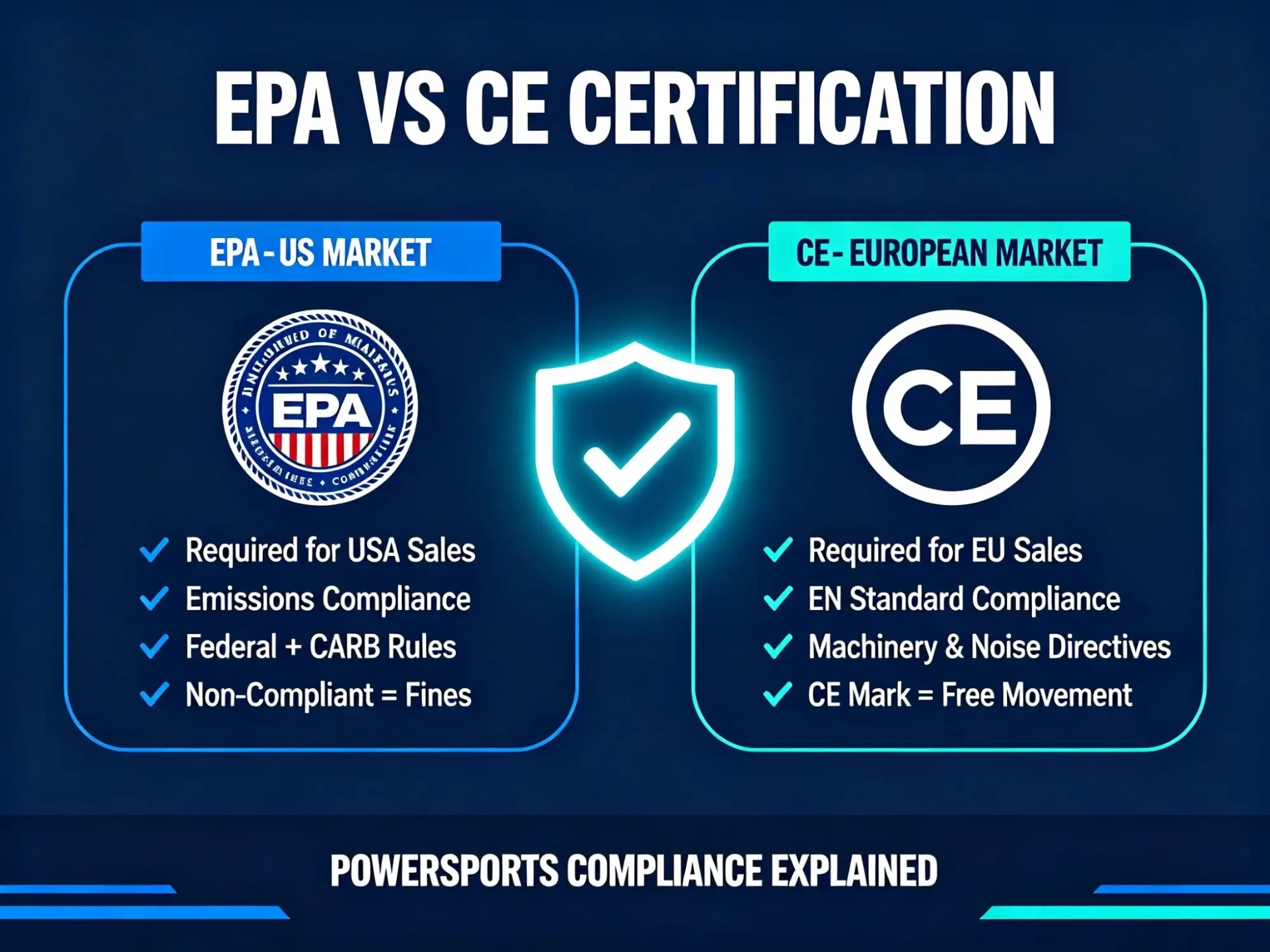
EPA vs CE certification — they are fundamentally different requirements for different markets, and you need the right one for where you sell.
EPA certification (U.S. Environmental Protection Agency) is a U.S. federal emissions compliance framework for covered nonroad engines and vehicles. Whether a powersports model needs a Certificate of Conformity depends on its product category, engine type, model year and applicable rule; confirm the exact scope before import. For sales in California, an additional CARB certification (California Air Resources Board) may be required, and some other states reference California standards. Electric vehicles do not produce tailpipe emissions, but can still be subject to other U.S. product, electrical, battery and transport requirements — verify current rules per category and market.
CE marking (Conformité Européenne) is the European Union market access mark used when an applicable EU regulation or directive requires it. The scope is broader than EPA and may include mechanical safety, electromagnetic compatibility (EMC), noise and environmental requirements. Many powersports products fall within one or more applicable frameworks, but the exact scope must be mapped by product category. CE is often based on the manufacturer’s Declaration of Conformity and technical file; some higher-risk categories require a notified body.
For dealers and importers:
- Selling in the United States? Confirm the applicable EPA requirement for the exact model, engine family and model year; check CARB and state rules for California-bound inventory.
- Selling in the European Union? You need CE marking. Verify the Declaration of Conformity and applicable test reports for each product before importing.
- Selling in both markets? You need both — and they are not interchangeable. EPA certification does not satisfy CE requirements, and CE marking does not satisfy EPA requirements.
EverJoy Moto can provide product configurations for both markets. Important: Certification status for specific models must be verified with our sales and engineering team — do not assume any model is certified for a specific market without confirmed documentation.
📌 Key Takeaways
EPA = U.S. emissions only. EPA is a federal emission standard for engines sold in the U.S. It covers one thing: exhaust emissions. The epa vs ce certification difference starts here — EPA is narrow and market-specific. CE = EU market access, broad scope. CE is the EU market entry mark covering safety, health, environmental protection, EMC, and noise — much broader than EPA. It's not just about emissions. They are not interchangeable. EPA certification does not satisfy EU requirements, and CE marking does not satisfy U.S. requirements. Selling in both markets requires both certifications. California needs CARB too. For U.S. sales, EPA covers the federal level, but California requires separate CARB certification (often stricter). Other states may adopt California standards — verify per state. Verify before you import. Always obtain and verify current certification documents (EPA Certificate of Conformity, CE Declaration of Conformity, test reports) for each specific model before importing. Regulations change — don't rely on outdated information. Consult professionals. This article is educational only. Work with a customs broker, compliance consultant, or the manufacturer's compliance team for your specific products and markets.
EPA vs CE Certification: The Complete Comparison Table
| Dimension | EPA Certification | CE Marking |
|---|---|---|
| Applicable market | United States (federal); California requires additional CARB; some states may adopt California standards | European Union (EU/EEA); also accepted in many other countries that reference EU standards |
| What it covers | Engine exhaust emissions only (hydrocarbons, carbon monoxide, nitrogen oxides, particulates depending on engine type); focused on air pollution | Broad: health, safety, environmental protection, mechanical safety, electromagnetic compatibility (EMC), noise, and emissions where applicable; covers the whole product, not just the engine |
| Governing body | U.S. Environmental Protection Agency (EPA); California Air Resources Board (CARB) for California | European Commission; individual EU member states enforce; standards developed by CEN/CENELEC/ETSI |
| Certification process | Manufacturer applies to EPA; requires test data from recognized laboratory; EPA reviews and issues Certificate of Conformity for an engine family; annual recertification typically required | Manufacturer (or authorized representative) assesses conformity against applicable EU directives/regulations; may involve testing by accredited lab; some categories require notified body involvement; manufacturer issues Declaration of Conformity and affixes CE mark |
| Testing requirements | Emissions testing on a representative engine from the engine family; durability testing; evaporative emissions testing (depending on category); test procedures defined by EPA regulations | Testing per applicable EU standards (safety, EMC, noise, emissions as applicable); test standards vary by product category; accredited laboratory testing typically required; technical documentation must be maintained |
| Product impact | Applies to the engine/engine family; vehicles using an EPA-certified engine may be eligible; engine configuration must match the certified configuration (no modifications that change emissions); electric vehicles may have different requirements | Applies to the complete product; all components and systems must meet applicable requirements; product design, labeling, and instructions must comply; modifications may require re-assessment |
| Cost | Varies significantly by engine family, displacement, and testing complexity; includes lab testing fees, certification application fees, and ongoing compliance costs; typically higher per engine family due to rigorous emissions testing (specific costs — consult certification specialist) | Varies by product category, applicable directives, and whether notified body is involved; includes testing fees, technical documentation, and possibly notified body fees; may be lower or higher than EPA depending on product (specific costs — consult certification specialist) |
This table is a general industry overview, not legal advice. Specific requirements, standards, test procedures, and costs vary by product category, engine size, model year, and market. Verify current requirements with the relevant regulatory authority and a qualified compliance professional before importing or selling any product.
EPA vs CE Certification: Applicable Market Analysis
Understanding which certification applies to which market is the foundation of compliance planning — and getting this wrong can result in detained shipments, fines, or forced product recalls.
EPA requirements apply to covered products in the United States market. EPA regulates exhaust emissions from nonroad spark-ignition engines, which commonly includes gasoline powersports categories. The exact Certificate of Conformity requirement must be confirmed by product category, engine family, model year and configuration. For California, a separate CARB Executive Order may be required, and some other states may reference California standards. Electric vehicles have no tailpipe emissions but may still be subject to CPSC, FCC, battery, charger and transport requirements.
CE marking applies to the European Union market (including EU member states and the EEA/EFTA countries in many cases). CE marking is a broader market access requirement — it indicates that the product complies with all applicable EU health, safety, and environmental protection legislation. Unlike EPA (which is specifically about emissions), CE covers the entire product across multiple dimensions: mechanical safety (e.g., Machinery Regulation), electromagnetic compatibility (EMC Directive), noise (Outdoor Noise Directive where applicable), and emissions (where relevant EU regulations exist). CE marking is also accepted or referenced in many non-EU countries that have adopted or aligned with EU standards — but dealers should verify acceptance per destination country. Important post-Brexit note: The UK now has its own UKCA marking requirement, and CE marking may not be sufficient for the UK market — verify current UK requirements separately.
Dealer implication: The first question in compliance planning is always "where are you selling?" If the answer is the U.S., focus on EPA (and CARB for California). If the answer is the EU, focus on CE. If the answer is both, you need a dual-certification strategy — and you should confirm with your manufacturer whether they can supply products certified for both markets. Never assume that a product certified for one market can be sold in the other. Always verify the specific certification documents for each model before placing an import order.
EPA vs CE Certification: Standards and Scope Analysis
The scope difference between EPA and CE is the most important conceptual distinction — EPA is narrow and focused, while CE is broad and comprehensive.
EPA certification has a single, focused scope: engine exhaust emissions. EPA regulations set specific limits on the amount of pollutants (hydrocarbons, carbon monoxide, nitrogen oxides, and in some cases particulates) that an engine can emit. The certification process verifies that the engine family meets these limits through standardized laboratory testing. EPA does not regulate the safety of the vehicle, its electromagnetic compatibility, its noise output (though there may be separate local noise regulations), or its mechanical integrity — those are covered by other U.S. agencies (such as CPSC for consumer product safety, or state/local regulations). This means that a vehicle can be EPA-certified for emissions but still fail to meet other U.S. requirements (e.g., CPSC safety standards, state noise laws). Dealers should not assume that EPA certification means the product is "fully compliant" for the U.S. market — it only means the engine meets federal emission standards.
CE marking has a broad, comprehensive scope: the entire product's compliance with all applicable EU requirements. CE is not a single standard — it's a mark that indicates the product has been assessed against all relevant EU directives and regulations. For powersports vehicles, this typically includes: the Machinery Regulation (safety of moving parts, controls, stability, protective features), the EMC Directive (electromagnetic compatibility for vehicles with electronic components), the Outdoor Noise Directive (where applicable, for certain equipment types), and any applicable emissions regulations (for nonroad mobile machinery). CE also requires proper labeling (CE mark, rated values, manufacturer information), instructions for use in the language(s) of the destination country, and maintenance of technical documentation. This broader scope means that CE compliance involves more than just emissions — it requires a holistic assessment of the product's safety and environmental impact.
Dealer implication: When comparing epa vs ce certification scope, be clear with customers and suppliers: EPA = emissions only; CE = whole-product compliance. If you're importing into the U.S., EPA certification is necessary but may not be sufficient — also check CPSC safety requirements, state regulations, and any local noise ordinances. If you're importing into the EU, CE marking should cover most requirements, but verify which specific directives apply to your product category (e.g., a go kart may have different applicable directives than an ATV). Always request the manufacturer's compliance documentation and review it with a qualified professional.
EPA vs CE Certification: Process and Testing Analysis
The certification processes for EPA and CE differ significantly in structure, timing, and the role of third parties — and these differences affect how manufacturers and dealers plan product launches.
EPA certification process typically involves the following general steps (specific requirements vary by engine category and model year): (1) The manufacturer selects an EPA-recognized laboratory to conduct emissions testing on a representative engine from the proposed engine family. (2) The laboratory performs standardized emissions tests (including exhaust emissions, evaporative emissions where applicable, and durability testing to verify emissions remain within limits over the engine's useful life). (3) The manufacturer submits an application for certification to EPA, including all test data, engineering descriptions, and production planning information. (4) EPA reviews the application and, if satisfied, issues a Certificate of Conformity for that engine family — typically valid for one model year, requiring annual recertification. (5) The manufacturer must maintain production-line testing and record-keeping to ensure production engines match the certified configuration. Key point: EPA certification is engine-family specific — a Certificate of Conformity covers one engine family, and any change to the engine (fuel system, displacement, aftertreatment) may require recertification. Testing is rigorous and conducted by EPA-recognized laboratories.
CE marking process typically involves the following general steps (specific requirements vary by product category and applicable directives): (1) The manufacturer (or authorized representative in the EU) identifies all applicable EU directives and regulations for the product. (2) The product is tested against the essential health and safety requirements of each applicable directive — often by an accredited testing laboratory, though for some directives the manufacturer may perform certain assessments internally. (3) For product categories that require notified body involvement (higher-risk categories), a third-party notified body must assess the product's conformity — for many powersports categories, notified body involvement may not be required for all directives, but dealers should verify per product. (4) The manufacturer compiles technical documentation (Technical File) demonstrating conformity, including test reports, design calculations, risk assessments, and instructions. (5) The manufacturer issues a Declaration of Conformity (a legal document signed by the manufacturer) and affixes the CE mark to the product. Key point: CE is often a self-certification framework (the manufacturer declares conformity, backed by technical documentation), though testing by accredited labs is typically required and notified body involvement depends on the product category and applicable directives.
Specific process steps, timelines, testing requirements, and costs vary significantly by product category, engine size, and regulatory changes. Verify current process requirements with the relevant regulatory authority and a qualified compliance professional.
Dealer implication: The process difference matters for inventory planning. EPA certification is engine-family based and requires annual recertification — so a model's EPA certification may expire at the end of a model year, and you should confirm that the units you're importing are covered by a current Certificate of Conformity. CE marking is product-based and typically doesn't expire annually (though it must be maintained if the product changes), but you should confirm that the Declaration of Conformity is current and covers the specific product configuration you're importing. Always ask the manufacturer for: (1) a copy of the current EPA Certificate of Conformity (for U.S.-bound units) or CE Declaration of Conformity (for EU-bound units); (2) confirmation that the specific model and configuration you're ordering matches the certified configuration; (3) any required labeling, instructions, and documentation for the destination market.
EPA vs CE Certification: Product Impact and Cost Analysis
Certification requirements directly affect product design, configuration, and cost — and understanding these impacts helps dealers plan inventory and pricing.
EPA certification product impact: EPA certification constrains the engine configuration — the engine must be built exactly as described in the Certificate of Conformity (fuel system, carburetor or fuel injection calibration, ignition timing, aftertreatment, evaporative system). This means that modifications to the engine (e.g., changing the exhaust, adjusting the carburetor, removing emissions controls) can void the certification and make the vehicle illegal to sell in the U.S. Dealers should not modify EPA-certified engines, and should be cautious about selling aftermarket parts that could affect emissions. EPA certification also requires specific labeling (emission control information labels, engine family labels) and may require evaporative emission controls (charcoal canisters, low-permeation fuel lines) depending on the engine category. For electric vehicles, EPA requirements may differ — verify current rules per product category.
CE marking product impact: CE marking affects the entire product design — safety features (guards, emergency stops, throttle controls), labeling (CE mark, warning labels in local languages), instructions for use (in the language(s) of the destination country), and electromagnetic compatibility (for vehicles with electronic ignition, electric motors, or electronic controls). CE may also require specific noise reduction measures (where the Outdoor Noise Directive applies) and specific safety interlocks. The product must be accompanied by EU-compliant instructions and safety information. Modifications to the product (changing components, adding accessories, altering safety features) may require re-assessment of CE conformity. Dealers should ensure that products they import have the correct CE labeling, documentation, and safety features for the EU market.
Cost considerations: Both EPA and CE certification involve costs — but the cost structure differs. EPA costs are typically concentrated in emissions testing (which can be significant, especially for durability testing) and annual recertification. These costs are usually borne by the manufacturer/engine supplier and may be reflected in the product's unit cost. CE costs are spread across multiple testing domains (safety, EMC, noise, emissions) and technical documentation, and may include notified body fees if required. CE costs may be lower or higher than EPA depending on the product category and whether notified body involvement is needed. Specific certification costs vary enormously by product category, engine size, testing complexity, and service provider — this article does not provide cost estimates. Dealers should consult a certification specialist or the manufacturer for cost information specific to their products.
Dealer implication: When evaluating products for different markets, consider the certification impact on product configuration and cost. A product configured for EPA (U.S.) may have different emissions controls, labeling, and documentation than the same product configured for CE (EU). Some manufacturers offer market-specific configurations — confirm with EverJoy sales which configurations are available for your target market. Also, factor certification costs into your total landed cost: the product price may include certification costs, but you may also incur costs for customs clearance, compliance verification, and any required market-specific modifications. Always verify that the product you're ordering is configured and certified for your specific destination market — don't assume a "one-size-fits-all" configuration works for both U.S. and EU.
EverJoy Compliance Support for Both Markets
EverJoy Moto understands that compliance is a critical concern for dealers and importers selling in multiple markets. We can provide product configurations designed to meet the requirements of both the U.S. (EPA/CARB) and EU (CE) markets — but certification status for specific models must be verified with our sales and engineering team before inventory planning or import.
What EverJoy Can Provide
- Market-specific configurations: Products can be configured with the appropriate emissions controls, safety features, labeling, and documentation for the U.S. market (EPA/CARB) or EU market (CE). Contact sales to confirm which configurations are available for each product category.
- Certification documentation: For models with current certification, EverJoy can provide copies of EPA Certificates of Conformity (for U.S.-bound units) and CE Declarations of Conformity with supporting test reports (for EU-bound units). Verify availability per model — not all models may be certified for all markets.
- Compliance guidance: Our team can provide general information about certification requirements for different product categories and markets, and can coordinate with our engineering and compliance partners to address specific questions.
- Multi-market planning: If you sell in both the U.S. and EU, we can help you understand the configuration differences and plan separate inventory for each market.
What Dealers Must Verify
Important — dealers and importers are ultimately responsible for compliance in their destination market. Before importing any product, you must:
- Verify certification status per model: Confirm with EverJoy sales that the specific model and configuration you're ordering has current, valid certification for your destination market (EPA Certificate of Conformity for U.S., CE Declaration of Conformity for EU). Do not assume certification — always request and verify the actual documents.
- Verify configuration match: Confirm that the product configuration (engine, emissions controls, safety features, labeling) matches the certified configuration. Modifications or configuration changes may invalidate certification.
- Verify destination-specific requirements: For the U.S., confirm whether your state requires CARB certification in addition to EPA. For the EU, confirm which specific directives apply to your product category and whether any country-specific requirements exist. For the UK, verify UKCA requirements separately.
- Consult professionals: Work with a customs broker, compliance consultant, or attorney who specializes in powersports imports for your market. They can review documentation, advise on current regulations, and help ensure smooth customs clearance.
- Maintain records: Keep copies of all certification documents, test reports, and correspondence for each imported shipment. Customs authorities may request these at any time.
Do not: Import products without verified certification documentation; assume that a product certified for one market can be sold in another; modify certified products in ways that may affect compliance; rely on outdated or expired certification documents; skip professional compliance review for high-value or high-volume imports.
Dealer Compliance Decision Framework
Use this framework to plan your certification strategy and avoid costly compliance mistakes.
Step 1: Define Your Markets
- Which countries will you sell in? (U.S. / EU / UK / other)
- If U.S.: Which states? (California and CARB states require additional certification)
- If EU: Which member states? (verify any country-specific requirements)
- Will you sell in multiple markets simultaneously? (requires dual-certification planning)
Step 2: Map Your Products to Requirements
- For each product category (ATV / UTV / dirt bike / go kart / mini bike / electric), identify the applicable certification requirements for each target market
- For gasoline products: map the applicable EPA/CARB requirements for the U.S. and the applicable CE framework for the EU; requirements differ by product category and are not interchangeable
- For electric products: Verify current requirements (may differ from gasoline; CE still applies for safety/EMC; EPA may have different or simplified requirements)
- Create a certification matrix: product × market × required certification × current status
Step 3: Verify Manufacturer Certification
- For each model you plan to import, request from EverJoy sales:
- Confirm that the specific configuration you're ordering matches the certified configuration
- Ask about certification expiration dates and renewal timelines
Step 4: Plan Inventory by Market
- Keep U.S.-bound (EPA/CARB) and EU-bound (CE) inventory separate — they may have different configurations, labeling, and documentation
- Do not commingle market-specific configurations in the same warehouse without clear identification
- Plan reorders around certification renewal cycles (EPA typically annual; verify CE status before reorders)
- Build buffer time for customs clearance — certification verification can delay shipments if documentation is incomplete
Step 5: Establish Compliance Review Process
- Designate a compliance point person in your organization
- Review all certification documents before each import order
- Maintain a compliance file for each product/market combination
- Schedule periodic reviews (at least annually) to check for regulatory changes
- Build relationships with a customs broker and compliance consultant for your market(s)
Multi-Market Compliance Strategy: Selling in Both U.S. and EU
For dealers who sell in both the U.S. and EU, a structured multi-market compliance strategy is essential — the two certification systems are not interchangeable, and trying to use one for the other market can result in detained shipments, penalties, or product recalls.
Key Principles for Multi-Market Compliance
- Separate configurations, separate inventory: U.S.-bound products should be configured and certified for EPA/CARB; EU-bound products should be configured and certified for CE. These may be different configurations (emissions controls, labeling, documentation, safety features). Keep them separate in your ordering and inventory.
- Verify before each shipment: Don't assume that because a model was certified last year, it's still certified this year. EPA certification is typically annual — verify the current Certificate of Conformity before each import season. CE should be verified for product configuration changes.
- Don't cross-sell configurations: A product configured and certified for the EU (CE) should not be sold in the U.S. without EPA certification, and vice versa. If a customer in one market wants a product configured for the other market, they need to understand that it may not be legally importable or saleable in their market.
- Budget for dual costs: If you sell in both markets, you may need to carry two configurations of the same product — one EPA/CARB, one CE. This increases inventory complexity and cost. Plan for this in your financial planning.
- Leverage manufacturer support: Work with EverJoy to understand which models are certified for which markets, and whether dual-certified configurations are available. Some manufacturers design products to meet both sets of requirements, reducing the need for separate configurations — verify availability per model.
Common Compliance Pitfalls to Avoid
- Assuming CE = EPA: CE marking does not satisfy U.S. EPA requirements, and EPA certification does not satisfy EU CE requirements. They are separate systems with separate standards.
- Forgetting CARB: EPA covers the federal U.S., but California (and some other states) requires CARB. Selling an EPA-only product in California can result in penalties.
- Ignoring UKCA: Post-Brexit, the UK has its own UKCA marking. CE marking may not be sufficient for the UK market — verify separately.
- Modifying certified products: Changing the exhaust, fuel system, or other emissions-related components can void EPA certification. Changing safety features or components can affect CE conformity. Always verify before modifying.
- Relying on expired certification: EPA certificates are typically model-year specific. Importing units covered by an expired certificate can result in customs detention.
- Skipping professional review: For high-value or high-volume imports, investing in a compliance consultant or customs broker review is far cheaper than dealing with detained shipments or penalties.
Action Plan for Dealers
Phase 1: Compliance Audit (Weeks 1-2)
- [ ] List all products you currently sell or plan to sell, by category and model
- [ ] Identify all target markets (U.S. states, EU countries, UK, others)
- [ ] Create a certification matrix: product × market × required certification × current status
- [ ] Request current certification documents from EverJoy for each model/market
- [ ] Review existing inventory for certification status and market configuration
Phase 2: Gap Analysis (Weeks 3-4)
- [ ] Identify products/markets where certification is missing, expired, or unverified
- [ ] Prioritize gaps by volume and risk (high-volume imports = high risk)
- [ ] Consult a customs broker or compliance advisor for your market(s)
- [ ] Determine whether existing products can be reconfigured for missing markets
- [ ] Estimate costs for obtaining missing certifications (via manufacturer)
Phase 3: Implementation (Weeks 5-8)
- [ ] Place orders only for products with verified, current certification for the destination market
- [ ] Separate inventory by market configuration (EPA/CARB vs CE)
- [ ] Establish a compliance review checklist for every import order
- [ ] Train purchasing and warehouse staff on certification requirements
- [ ] Set up a compliance file system for all certification documents
Phase 4: Ongoing Compliance (Continuous)
- [ ] Review certification status before each reorder
- [ ] Track EPA certification renewal cycles (typically annual)
- [ ] Monitor regulatory changes in all target markets
- [ ] Schedule annual compliance reviews with your consultant/broker
- [ ] Maintain audit-ready records for all imports
KPI Targets
| KPI | Target | How to Measure |
|---|---|---|
| Certification verification rate | 100% before import | Every import order has verified, current certification docs on file |
| Customs detention rate | <1% for certification issues | Number of detained shipments ÷ total shipments |
| Compliance documentation completeness | 100% | Audit of compliance files: all required docs present and current |
| Certification renewal on-time rate | 100% | EPA certificates renewed before expiration for active models |
| Market configuration accuracy | 100% | No cross-market configuration errors in inventory |
KPI targets are general compliance management references, not regulatory requirements. Actual targets should be set based on your business size, import volume, and risk tolerance.
Frequently Asked Questions
Dealer Compliance Decision Checklist
Before importing or selling a model, verify the exact SKU, model year, engine or battery system, destination market, applicable legal framework, certificate or declaration holder, test reports, labels, manuals and configuration revision. EPA, CE, CARB, CPSC, charger and battery documents are not interchangeable and do not automatically transfer across models, markets or modified configurations. Use current documents and qualified compliance advice; this checklist is not a legal determination.
| Item | Gasoline product | Electric product |
|---|---|---|
| Emissions | Confirm the applicable EPA/CARB or other market requirement by model and state | Confirm whether emissions rules apply; review other applicable product requirements |
| Product safety | Confirm CPSC and applicable vehicle/product rules | Confirm CPSC, electrical, charger, battery and applicable product rules |
| EU/UK access | Confirm the applicable CE/UKCA framework and Declaration of Conformity | Confirm the applicable CE/UKCA framework, electrical and battery documents |
| Import file | Certificate/declaration scope, labels, invoice, packing list and broker requirements | Battery transport documents, charger data, labels, invoice, packing list and broker requirements |
Official Reference Starting Points
These links are starting points, not a substitute for checking the current rule and product-specific documentation.
Q: EPA vs CE certification — what's the difference?
A: EPA is a U.S. federal emissions framework for covered engines and vehicles; the exact approval depends on product category, engine family and model year. CE is an EU conformity mark used when an applicable regulation or directive requires it, covering the relevant product safety and environmental requirements. They are not interchangeable. A dealer selling in both markets must map and satisfy the applicable requirements in each market. This article is educational — verify current rules with a compliance professional.
Q: Do I need EPA certification for electric powersports vehicles?
A: EPA requirements for electric vehicles may differ from gasoline vehicles, as electric vehicles do not produce tailpipe emissions. However, electric vehicles may still be subject to other U.S. federal requirements (e.g., CPSC consumer product safety, FCC for electronic components, DOE for battery/energy efficiency where applicable). The specific requirements depend on the product category and current regulations. Do not assume electric vehicles are exempt from all U.S. requirements — verify current EPA and other federal requirements per product category with a qualified compliance professional. For the EU, CE marking still applies to electric vehicles (covering safety, EMC, and other applicable directives).
Q: Is CARB required in all U.S. states, or just California?
A: CARB (California Air Resources Board) certification is specifically required for vehicles sold in California. However, some other U.S. states have adopted or reference California's emission standards (often called "CARB states" or "ZEV states"), and the number of states following California standards can change. Additionally, some states may have their own requirements. Always verify the specific requirements for each state where you plan to sell — don't assume EPA federal certification is sufficient everywhere. When in doubt, consult a compliance advisor or the state's environmental agency.
Q: How long does EPA or CE certification take, and how much does it cost?
A: Certification timelines and costs vary enormously depending on the product category, engine size, testing complexity, current regulatory workload, and whether any issues arise during testing. EPA certification involves rigorous emissions testing (including durability testing) and agency review, and is typically renewed annually. CE involves testing across multiple domains (safety, EMC, noise, emissions) and technical documentation, with possible notified body involvement. This article does not provide specific timeline or cost estimates — they are too variable and change frequently. Consult a certification specialist, testing laboratory, or the manufacturer's compliance team for current estimates specific to your product.
Q: Can a product be both EPA and CE certified?
A: Yes — a product can be designed, tested, and certified to meet both EPA (U.S.) and CE (EU) requirements. However, this may require specific design and configuration choices to satisfy both sets of standards, and the certification processes are separate (EPA Certificate of Conformity + CE Declaration of Conformity). Some manufacturers offer dual-certified configurations, while others may require separate configurations for each market. Verify with EverJoy sales whether specific models are available in dual-certified or market-specific configurations, and request the actual certification documents for each market before importing.
Q: What happens if I import a product without the required certification?
A: Importing or selling a product without the required certification can have serious consequences: customs may detain or refuse entry to the shipment; regulatory agencies may impose fines or penalties; the product may be required to be recalled, re-exported, or destroyed; and the importer/dealer may be subject to legal action. For EPA violations, penalties can include significant per-unit fines. For CE violations, the product may be barred from the EU market and the importer may face enforcement action from member state authorities. The cost of non-compliance far exceeds the cost of proper certification and compliance review. Always verify certification before importing, and work with qualified professionals.
Q: How does EverJoy support dealers with EPA and CE compliance?
A: EverJoy can provide product configurations designed for both the U.S. (EPA/CARB) and EU (CE) markets, and can provide certification documentation for models with current certification. Our team can coordinate with engineering and compliance partners to address specific questions about product configurations and market requirements. However, certification status for specific models must be verified with our sales team — do not assume any model is certified for any market without confirmed documentation. Dealers and importers are ultimately responsible for compliance in their destination market, and should consult professional compliance advisors. Contact EverJoy sales to discuss your specific market and product needs, and to request current certification documents for the models you're interested in.
Ready to Navigate EPA and CE Compliance for Your Powersports Inventory?
EPA and CE certification are not obstacles — they're the foundation of legal, profitable import and sales in the world's two largest powersports markets. EPA for the U.S. (emissions, plus CARB for California). CE for the EU (broad safety, health, and environmental compliance). Both are required for their respective markets, and neither substitutes for the other. The key is knowing which applies where, verifying documentation before every import, and working with a manufacturer who understands both markets.
EverJoy Moto can provide product configurations for both U.S. (EPA/CARB) and EU (CE) markets, with certification documentation available for verified models. Important: Certification status for specific models must be verified with our sales and engineering team — contact us to confirm which models are certified for your target market, and to request current certification documents.
- Request EPA + CE certification status for your models →
- Verify current certification documents per model →
- Discuss multi-market product configurations →
- Talk to a compliance and product specialist →
EverJoy Moto — EPA for the U.S., CE for the EU. Both markets, one manufacturing partner. Verify before you import.
Disclaimer: This article is for educational and informational purposes only and does not constitute legal, compliance, trade, or tax advice. EPA and CE regulations, standards, testing requirements, fees, and enforcement policies change frequently and vary by product category, engine size, model year, and specific market (including U.S. states and EU member states). All descriptions in this article are general overviews and may not reflect the most current requirements. EverJoy Moto does not warrant or guarantee the accuracy, completeness, or timeliness of the information in this article, and shall not be liable for any loss, damage, or penalty arising from reliance on this information. Dealers and importers must: (1) verify current regulatory requirements with the relevant authorities (EPA, CARB, European Commission, national authorities); (2) obtain and review current certification documents (EPA Certificate of Conformity, CE Declaration of Conformity, test reports) for each specific product and configuration; (3) consult qualified compliance professionals, customs brokers, and legal advisors; (4) confirm certification status per model with EverJoy sales before importing. Certification status for all EverJoy models must be verified — do not assume any model is certified for any market without confirmed documentation. Product specifications and configurations are subject to change. Always maintain compliance records and conduct periodic compliance reviews.